




Overview
Vision
To establish a culture of continuous institutional self-evaluation and quality enhancement, transforming Thanthai Periyar Government Institute of Technology (TPGIT) into a center of excellence in technical education, innovative research, and socio-economic empowerment.
Mission
- Academic Excellence: Develop and monitor quality benchmarks across academic programs, curriculum delivery, and evaluation practices to meet global standards.
- Faculty & Staff Empowerment: Foster professional development and continuous upskilling of faculty through training, research initiatives, and pedagogical advancements.
- Student-Centric Growth: Promote holistic growth by nurturing critical thinking, technical proficiency, ethical values, and entrepreneurship among students.
- Institutional Governance: Systematize administrative and operational processes to ensure transparency, accountability, and seamless accreditation readiness (NBA/NAAC).
- Stakeholder Engagement: Actively collaborate with industry, alumni, and community partners to align engineering education with real-world technological and societal needs.
Functionalities of IQAC
The Internal Quality Assurance Cell (IQAC) serves as the nodal agency for quality-related activities across TPGIT:
- Setting Quality Benchmarks: Defining parameters for academic, administrative, and research activities in alignment with regulatory bodies like Anna University, AICTE, and NAAC.
- Curriculum & Delivery Enhancement: Monitoring Outcome-Based Education (OBE) frameworks, course outcomes (COs), program outcomes (POs), and modern teaching methodologies.
- Conducting Audits: Executing regular Academic and Administrative Audits (AAA) to evaluate efficiency and identify areas requiring intervention.
- Stakeholder Feedback Mechanism: Collecting, analyzing, and acting upon structured feedback from students, parents, alumni, and employers
- Data Management & Reporting: Compiling the Annual Quality Assurance Report (AQAR) and maintaining centralized documentation for institutional accreditations and rankings.
- Promoting Research & Innovation: Facilitating funded projects, patents, journal publications, and technical workshops across departments.
Benefits of IQAC
Implementing a robust IQAC Framework provides measurable institutional advantages:
- Accreditation Readiness: Simplifies preparation for NAAC accreditation, NBA accreditation for individual departments, and NIRF rankings through organized documentation.
- Structured Decision-Making: Provides data-driven insights to the leadership for resource allocation, infrastructure development, and policy changes.
- Enhanced Employability: Ensures the curriculum and skill-development workshops remain aligned with industrial demands, boosting campus recruitment.
- Consistent Quality Culture: Replaces sporadic improvements with an institutionalized, continuous quality improvement loop (Plan-Do-Check-Act).
- Transparency & Accountability: Establishes standard operating procedures (SOPs) for administrative and academic workflows across all departments.
Strategies of IQAC
IQAC employs the following strategic approaches to realize its goals:
- Outcome-Based Education (OBE) Integration: Enforce rigorous mapping of COs-POs and continuously assess attainment levels across all engineering disciplines.
- Digital Transformation: Leverage Learning Management Systems (LMS), digital campus portals, and online feedback platforms to streamline academic tracking.
- Faculty Development Initiatives: Mandate participation in AICTE Training and Learning (ATAL) academies, industrial training, and collaborative research projects.
- Quality Awareness Programs: Organize regular seminars, workshops, and orientation programs on quality maintenance for staff and students.
- Continuous Feedback Loop: Ensure timely implementation of corrective measures based on internal audit findings and stakeholder suggestions.
Composition
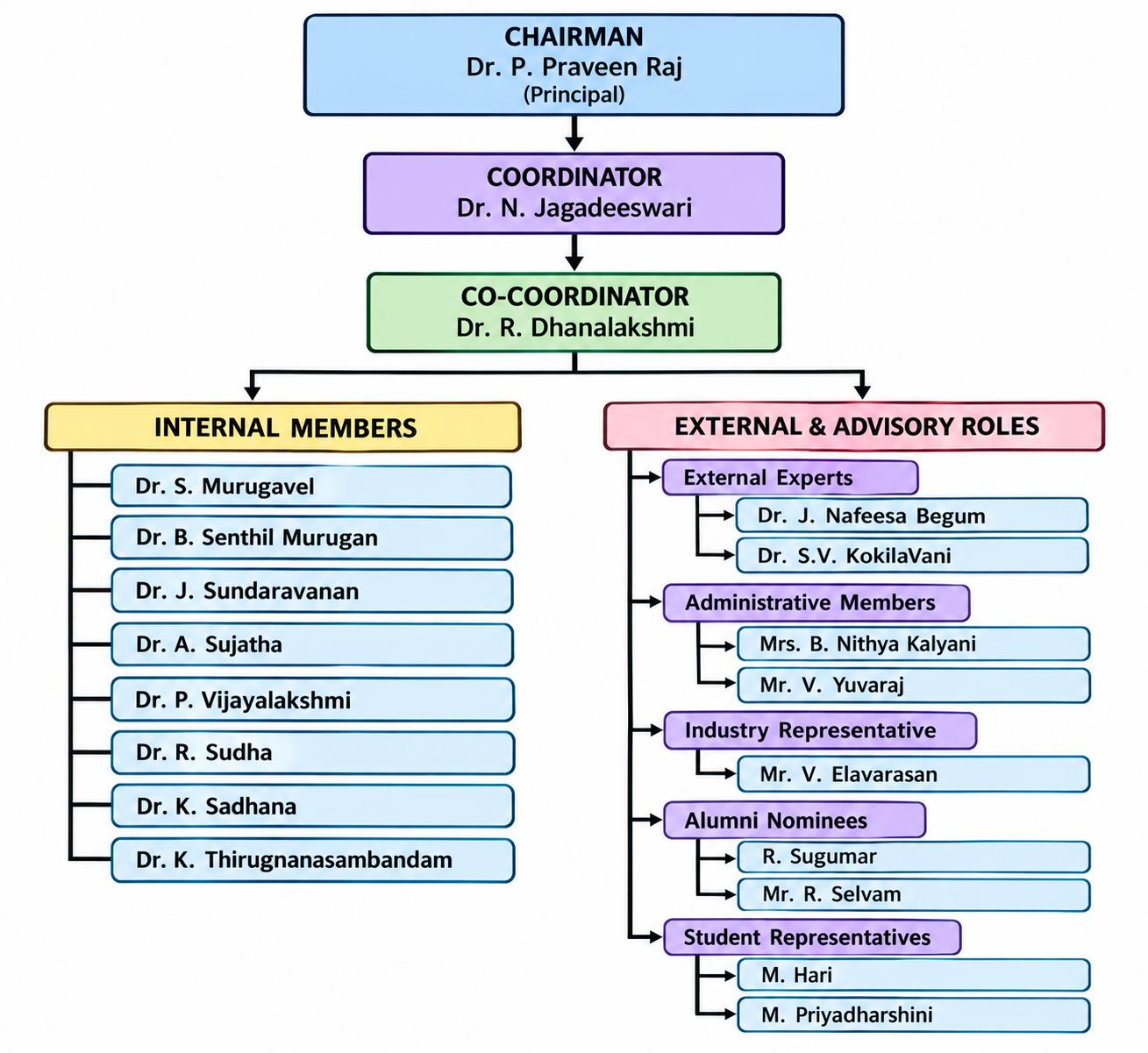
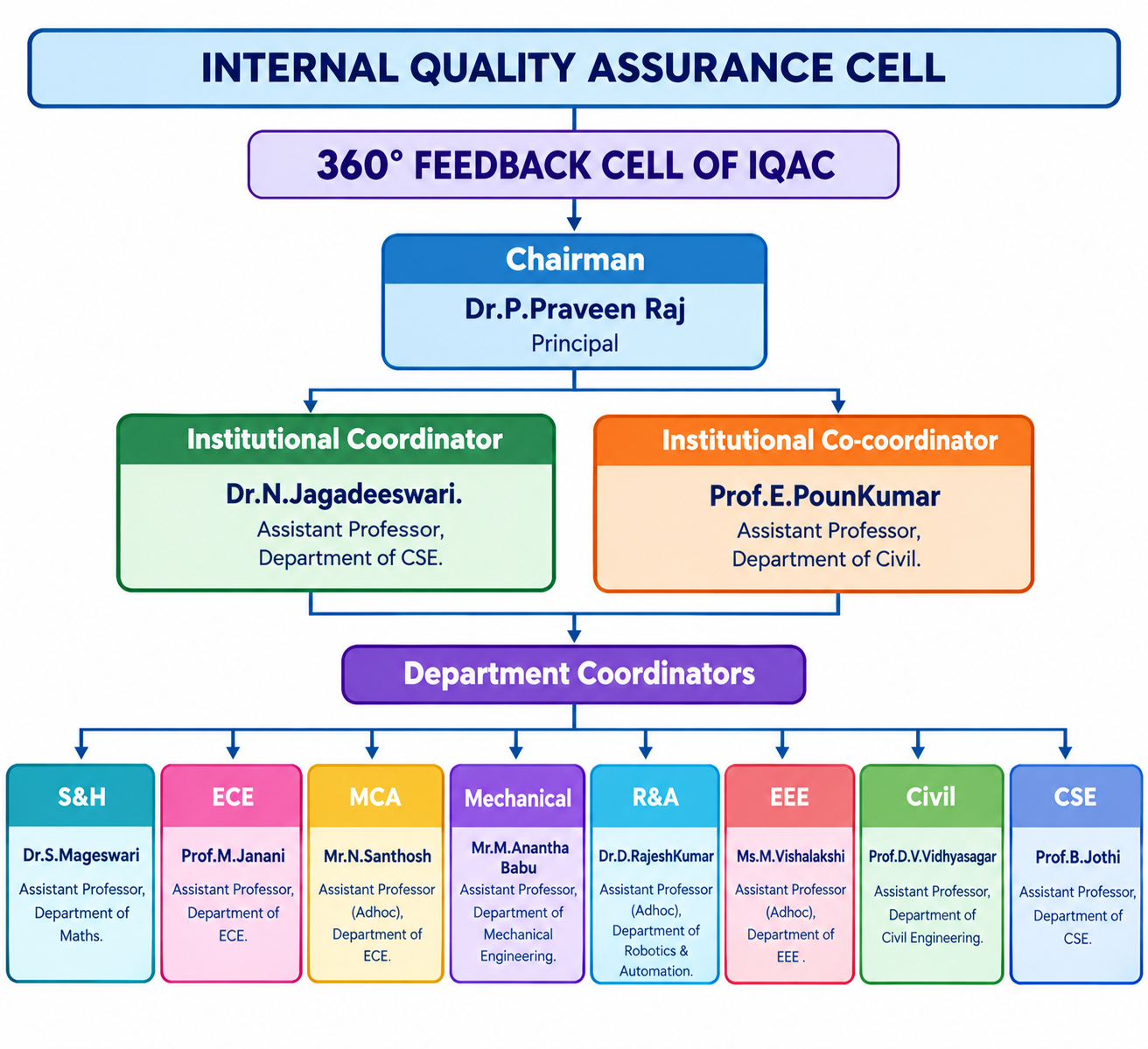
360 Degree Feedback Cell
AQAR
Annual Quality Assurance Reports (AQAR) will be available here.
Internal Audit
Academic Administrative Audit
Academic Administrative Audit details will be updated here.
Lab Audit
Laboratory Audit details will be updated here.
Year Planner
S.No | Academic Year | Meeting Documents |
|---|---|---|
1 | 2026-2027 |
Circular
S.No | Circular no&Date | Documents |
|---|---|---|
1 | 01/2026/IQAC & 06-07-2026 | |
2 | 01/2026/360D/IQAC & 06-07-2026 | |
3 | 01/2026/IQAC & 05-08-2026 |
Minutes of Meeting
S.No | Documents |
|---|---|
1 |
Institute Academic Affairs Committee(IAAC)
The Institute Academic Affairs Committee shall function under the chairpersonship of the Head of the Institution.
Functions of the Committee:
- 1.Review the academic performance of students periodically.
- 2.Identify difficulties experienced by students in the classroom and laboratories, and recommend remedial measures.
- 3.Address academic issues raised by students.
- 4.Review student performance after internal assessments and recommend corrective actions.
- 5.Suggest measures for improving the quality of teaching and learning.
- 6.Maintain minutes of meetings and submit recommendations to the Principal.
- 7.Communicate the minutes of each meeting to faculty members, students, and stakeholders.
- 8.Perform all functions assigned under Anna University Regulations 2025.
IAAC Members
S.No. | Name and Designation | Position |
|---|---|---|
1 | Dr. P. Praveenraj, Principal, Asso. Professor and Head, Dept. of ME | Chairperson |
2 | Dr. S. Selvi, Asso. Professor and Head, Department of CSE | Member Secretary |
3 | Dr. S. Murugavel, Professor and Head, Dept. of Physics | Faculty Representative |
4 | Dr. N. Kalaivasan,Professor and Head, Dept. of Chemistry | Faculty Representative |
5 | Dr. D. BabuAsso. Professor and Head, Dept. of Mathematics | Faculty Representative |
6 | Dr. J. Sundaravanan, Asso. Professor and Head, Dept. of ECE | Faculty Representative |
7 | Dr. K. Anbukkarasi, Asso. Professor and Head, Dept. of CE | Faculty Representative |
8 | Dr. P. VijayalakshmiAsst. Professor, Dept. of R & A | Faculty Representative |
9 | Dr. B. Senthil Murugan, Asso. Professor and Head, Dept. of EEE | Faculty Representative |
10 | Thiru. K. KarthikeyanAsst. Professor and Head, Dept. of English | Faculty Representative |
11 | V. Krishnaraj (513125104017) II Year/CSE | Student Representative (Boy) |
12 | V. Rishivika (513125104030) II Year/CSE | Student Representative (Girl) |
13 | D. Kanishka (513125103018)II Year/CE | Student Representative (Girl) |
14 | K. Praveen (513125103031)II Year/CE | Student Representative (Boy) |
15 | M. Mariselvam (513125114043)II Year/ME-A | Student Representative (Boy) |
16 | R. Hemavarshini (513125114023)II Year/ME-A | Student Representative (Girl) |
17 | N. Vishnu (513125114091)II Year/ME-B | Student Representative (Boy) |
18 | S. Thirumagalsri (513125114081)II Year/ME-B | Student Representative (Girl) |
19 | R. Sripriya (513125125041)II Year/R&A | Student Representative (Girl) |
20 | EK. Elamaran (513125125013)II Year/R&A | Student Representative (Boy) |
21 | M. Sakthi (513125105038)II Year/EEE | Student Representative (Girl) |
22 | Khaleeq Ahmed (513125105022)II Year/EEE | Student Representative (Boy) |
23 | C. Gowtham (513125106023)II Year/ECE-A | Student Representative (Boy) |
24 | J. Joshini Devi (513125106033)II Year/ECE-A | Student Representative (Girl) |
25 | K. Subalakshmi (513125106087)II Year/ECE-B | Student Representative (Girl) |
26 | S. Shakthivel (513125106081)II Year/ECE-B | Student Representative (Boy) |